
What is polycarbonate? You need to know everything
2025-03-25
Catalog
1. Definition of polycarbonate
Polycarbonate, also known as "PC plastic", is a thermoplastic polymer engineering plastic material. Due to its excellent transparency, impact resistance, heat resistance and dimensional stability, it is used in many fields.
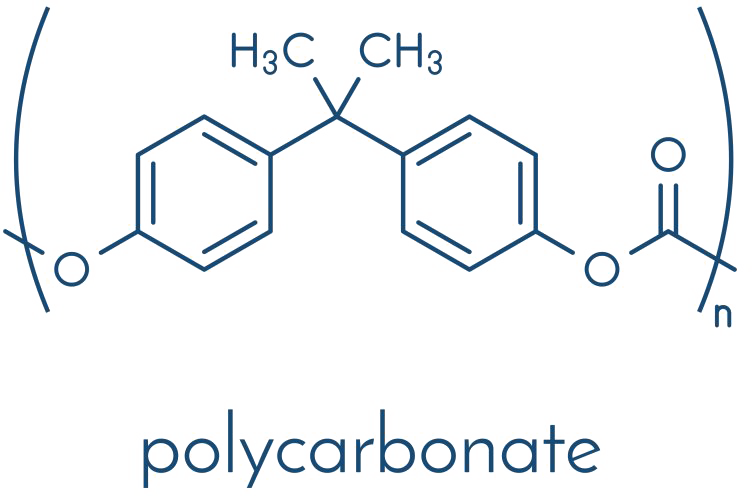
The basic chemical formula of polycarbonate (PC) is (C₁₅H₁₆O₂)n, of which the most common is bisphenol A polycarbonate (BPA-PC). Its molecular structure contains carbonate groups (-O-(C=O)-O-) and aromatic rings. The figure left is a molecular structure diagram of polycarbonate material
2. Characteristics of polycarbonate
Polycarbonate contains carbonate groups (-O-(C=O)-O-) in its molecular structure, which gives the material many characteristics. The main characteristics are as follows

-
High transparency, with a transmittance of up to 89%, almost the same as glass, and is often used in the manufacture of optical lenses and goggles
-
Excellent impact resistance, which is a hundred times higher than that of ordinary glass; even compared with impact-resistant acrylic materials (PMMA), the impact resistance is dozens of times higher. Compared with other plastic materials, polycarbonate can still maintain good impact resistance in low temperature environments
-
Good heat resistance and flame retardant properties, polycarbonate materials can be used normally in the range of -40℃-120℃, and modified polycarbonate materials can withstand higher temperatures. At the same time, most polycarbonate materials have good self-extinguishing properties, and generally can meet the UL94 V-0 flame retardant standard
-
Dimensionally stable, less affected by temperature and humidity, suitable for precision industrial manufacturing
-
Good insulation performance. In the field of electronic and electrical equipment, polycarbonate materials are also fully used
3. Polycarbonate processing
Polycarbonate is mainly produced by the transesterification polymerization reaction of bisphenol A (BPA) and phosgene (COCl₂) or diphenyl carbonate (DPC). At present, the melt transesterification method is mainly used to produce polycarbonate in the world. This method is environmentally friendly and efficient, and has gradually replaced the traditional phosgene method.
Although BPA is contained in the processing of polycarbonate, BPA is firmly bound to the polymer chain by chemical bonds. Under normal temperature and acid-free and alkali-free environment, it is generally not released into water and food. Even if it is released, it is within the food safety standard. Therefore, it can be used as a raw material for drinking water bottles, but it is not recommended to hold acidic and alkaline and pickled foods. At the same time, many manufacturers have also launched BPA-Free PC water bottles, using other BPA-free alternative materials, such as copolyester (Tritan), polyethersulfone (PES), etc.
Although BPA is contained in the processing of polycarbonate, BPA is firmly bound to the polymer chain by chemical bonds. Under normal temperature and acid-free and alkali-free environment, it is generally not released into water and food. Even if it is released, it is within the food safety standard. Therefore, it can be used as a raw material for drinking water bottles, but it is not recommended to hold acidic and alkaline and pickled foods. At the same time, many manufacturers have also launched BPA-Free PC water bottles, using other BPA-free alternative materials, such as copolyester (Tritan), polyethersulfone (PES), etc.
4. Application of polycarbonate
Due to its excellent performance, polycarbonate is widely used in various industries
-
Electronic and electrical equipment: mobile phone housing, laptop housing, LED lampshade, electrical junction box
-
Automobile manufacturing: headlight housing, instrument panel, car window, windshield, etc.
-
Building materials: PC greenhouse board, endurance board, skylight, safety protection window, etc.
-
Medical equipment: medical instruments, test tubes, dialyzer housing, etc.
-
Safety protection: bulletproof glass, helmets, goggles, etc.
-
Optical field: eyeglass lenses, optical discs (CD, DVD, Blu-ray disc), etc.
5. Why choose Luoyang Baiyou as supplier of polycarbonate pellets?
- Industry leading supplier, 30+ years of cooperation with large petrochemical plants, deeply trusted by buyers
- Experienced manufacturer, 20+ years of experience in plastic product manufacturing, 50+ technicians to provide technical support, 500+ front-line employees
- Warehouses are set up in multiple ports to achieve fast delivery of goods
-
Strong financial strength to meet the ultra-large-scale raw material procurement needs
6. Conclusion
Polycarbonate is an engineering plastic material with superior performance. Due to its excellent transparency, impact resistance, heat resistance and electrical insulation properties, it is widely used in construction, medical treatment, safety protection, automobile manufacturing and other fields.
The difference of POM-C and POM-H
Polycarbonate (PC) : Features and applications