
• image English
    • image Español
    • image Pусский
    • image Portugues
    • image Français
    qr Code Url

    Scan qrcode to view mobile website

    Member Center
    Exit
    Data is empty
    0

    Get Free Quotation

    Home /News /Engineering plastics /Comparative analysis of dry PP diaphragm and wet PE diaphragm in lithium batteries /

    Comparative analysis of dry PP diaphragm and wet PE diaphragm in lithium batteries

    2025-07-09
    The role of battery separators in lithium-ion batteries
    Lithium-ion battery separator (Separator) is a key functional film material located between the positive and negative electrodes in the battery structure.
    Lithium-ion battery separator (Separator) blocks electrons, preventing short circuits, but also allows lithium ions to travel through and support the charging and discharging process of the battery.
    Its role is not only to physically isolate the positive and negative electrodes, but also directly affects the safety, ion transfer efficiency, cycle life and thermal stability of the battery.
    With the rapid development of new energy vehicles, energy storage and consumer electronics industries, the requirements for lithium-ion battery performance, safety and cost continue to rise. Battery diaphragm, as one of the four core materials of the battery, plays a crucial role in ensuring the normal operation of the battery and thermal runaway protection. Currently, the mainstream diaphragm technologies in the market mainly include polypropylene (PP) dry diaphragm and ultra-high molecular weight polyethylene (UHMWPE) wet diaphragm. These two diaphragms have their own characteristics in terms of raw material, process, structure, performance and application direction, and will be systematically compared and analyzed in this paper. 

    Ⅰ. Differences in raw materials and process paths

    • Dry diaphragm mainly adopts high isotactic polypropylene as raw material, and forms microporous structure through melt extrusion, shaping and bi-directional stretching. The core of the process lies in the formation of micropores induced by stretching, and the whole process does not use solvents, which is environmentally friendly.
    • Wet diaphragms, on the other hand, use ultra high molecular weight polyethylene as the substrate, mixed with paraffin or liquid hydrocarbons to prepare a colloidal fluid, which is calendered into a film, then solvent extracted to remove the oil phase, and bi-directionally stretched to form a dense, microporous structure. This process is more demanding in terms of equipment and purification systems, but results in porous diaphragms with higher porosity and smaller pore sizes.

    II. Microstructure and performance comparison

    Polypropylene dry diaphragm (PP)
    Ultra-high polymer polyethylene wet diaphragm (PE)
    Microstructure Trapezoidal pores, fibrous arrangement, regular structure Reticulated porous structure with smaller and denser pores
    Thickness Range
    16–25 μm
    8–20 μm
    Porosity
    35–45%
    40–60%
    Thermal shutdown temperature
    160–165 °C(PP melting point)
    130–140 °C(PE melting point)
    Electrolyte Wettability Medium, needs surface treatment Good, high liquid absorption
    Mechanical strength High transverse strength and good puncture resistance Good flexibility, but weak laterally
    Costs relatively low relatively high

    III. Differences in application areas

    Areas of application
    Common Diaphragm Types
    Power battery (lithium iron phosphate)
    PP dry diaphragm
    Power battery (lithium ternary)
    PE wet diaphragm
    Energy storage batteries
    PP dry diaphragm-based
    Consumer electronics (cell phones, laptop computers)
    PE wet diaphragms are more common

    IV. Representative raw material companies and main products
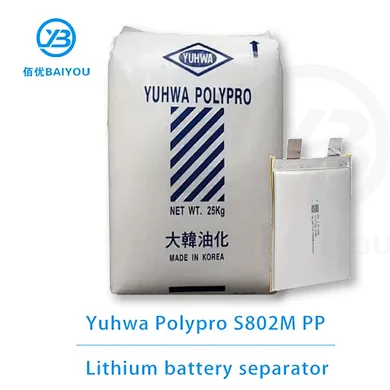
    Lithium battery separator (LiBS) is produced by dry treatment, mainly made of ultra-high purity polypropylene.Lithium battery stretch diaphragm can be manufactured without adding any additives, so the manufacturing technology and equipment requirements are relatively low and the cost is relatively low.
    Common manufacturers include Yuhwa Polypro series, Singapore TPC, Lotte Chemical. The main production grades include Yuhwa Polypro S802M, Singapore TPC FS2014 and Lotte Chemical BS-120. The most important supplier is Yuhwa Korea petrochemical.
    yuwha polypro S802M polypropylene

    Yuhwa Polypro S802M high-purity polypropylene

    It is the main raw material for manufacturing lithium battery separator (LiBS) using dry processing in the world. It has excellent low gray performance and rigidity, effectively ensuring the safety and stability of lithium batteries. 
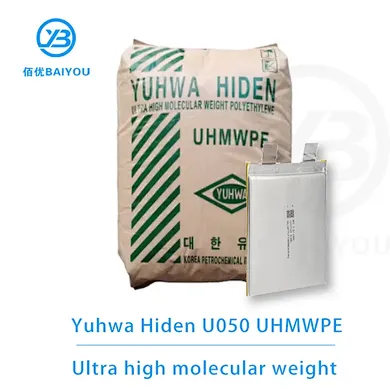
    The wet process for manufacturing lithium battery separators (LiBS), mainly realized by using ultra high molecular weight polyethylene. It can produce thinner films with higher porosity and more uniform microporous structures. Therefore, it has become one of the mainstream application technologies for high-energy density batteries.
    It is mainly used in the manufacture of separators for high level power batteries and consumer batteries. Since oily substances need to be mixed into the manufacturing process to form a fluid structure, it is called a wet process. Compared with the dry process, the wet process is more expensive and requires higher technology and equipment.
    Currently, the world's mainstream ultra-high molecular weight polyethylene manufacturers mainly used for the production of battery separators are Yuhwa's Hiden series and Asahi Kasei's Sunfine series. Common raw materials include Yuhwa Hiden U050 UHMWPE and Asahi Kasei Sunfine UH650 UHMWPE.
    yuhwa hiden u050 uhmwpe

    Yuhwa Hiden U050 UHMWPE

    This resin material is the main raw material for the manufacturing of battery separators produced by Yuhwa. It has excellent impact resistance and superior processing performance. Compared with conventional ultra-high molecular weight polyethylene materials, it has a more convenient processing procedure. At the same time, it is cheaper than Asahi Kasei's ultra high molecular weight polyethylene, so it is welcomed by battery manufacturers from China.

    Asahi Kasei UH650 UHMWPE

    Asahi Kasei has been exploring the manufacturing of battery separators since the early days of lithium battery development, and now has a very complete product system to meet the needs of different manufacturers.
    Sunfine UH650 UHMWPE material adopts a molecular weight design to improve the puncture resistance and impact resistance of the separator; it uses Asahi Kasei's own advanced catalytic technology to minimize metal residues, effectively reducing the risk of equipment damage and effectively improving battery safety.

    V. Conclusion

    • Dry PP diaphragm is widely used in lithium iron phosphate batteries, energy storage systems and some low-end consumer electronics products due to its relatively low cost and stable structure.
    • Wet PE diaphragms are dominant in ternary systems, high rate batteries, high-end power batteries (e.g. electric vehicles) and consumer electronics due to their excellent thermal shutdown capability and electrolyte affinity.
    Share:

    What is LCP material

    Solutions for Yellowing of Polycarbonate

    Ask a quote for the latest price and one of our team members will respond as soon as possible. Fields marked with * are required.

    Quote For The Latest Price

    SiteMap

    mainly export PP, PE, PC, POM, EVA, ABS, PS, PET plastic raw material granules, which are used in making FIBC bags, office equipment, home appliances, auto parts, agricultural products, pipes and other fields.

    Products

    PP

    PE

    EVA

    PC

    ABS

    PS

    PET

    POM

    Get In Touch

    Telephone:0379—64627811

    WhatsApp:+86 15837933829

    Email:info@polyhdpe.com

    Address:Room 2505, Building 2#, Yinkun Science and Technology Park, Fenghua Road, Luoyang City, Henan Province, China

    © Copyright 2022 Pon Pure Chemicals Group | All Rights Reserved

    (420259)
    0
    Service

    Inquiry
    Inquiry
    WhatsApp
    8615837933829
    Top