
Processing Defects of Hostaform POM and Solutions - 2
1. Ripples Caused by Poor Liquidity
Different grades of Hostaform POM have different flow properties. Hostaform C 9021, a medium-viscosity POM material, is typically selected for injection molding. With a melt index of 9, this material is suitable for the vast majority of injection molding machines but is not suitable for extrusion molding of thick-walled products.
⚠️If you need to process thick-walled products, we recommend Hostaform C2521, which has a melt flow index of 2.5 and lower flow properties, making it less prone to warpage defects and suitable for processing thick-walled profiles such as sheets and bars.

2. Material Degradation Defects Caused by Uncleaned Molds
Acetal is a typical heat-sensitive material. Although Hostaform POM-C has a wider processing temperature range than Delrin POM-H, it is still lower than that of typical thermoplastic polymers (generally 190–210°C); excessively high processing temperatures can cause thermal degradation of POM.
2.1 Impact on Products and Performance
- Surface Defects: Common defects include surface bubbles and pitting. Formaldehyde gas released by Hostaform POM during thermal degradation becomes incorporated into the material, causing surface defects.
- Black spots and discoloration: These defects are caused by POM that has remained in the mold or runner for an extended period, resulting in carbonization due to prolonged exposure to heat, which causes it to turn yellow or black.
- Deterioration in mechanical properties. Thermal degradation disrupts the molecular chain structure of Hostaform, resulting in a significant reduction in impact strength, toughness, and dimensional stability in products containing residual material.
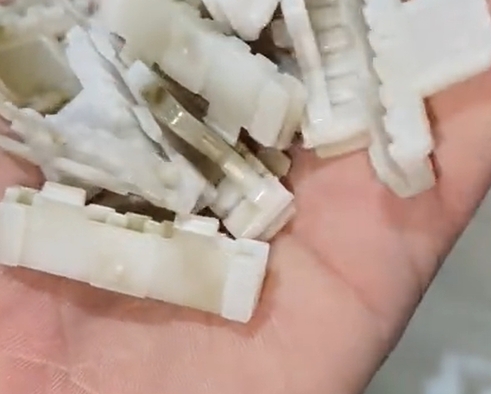
The image on the right shows product defects caused by residual POM that remained after the mold was not thoroughly cleaned following the use of Hostafrm POM material. These defects resulted from repeated heating. It is clearly visible that some of the residual material was not removed, leading to partial carbonization and yellowing due to oxidation.
3. Bubbles or silver streaks caused by high temperatures
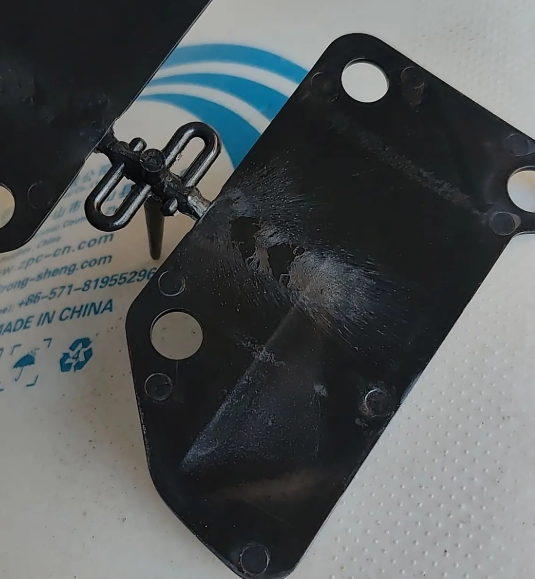
POM has poor thermal stability; under high-temperature processing conditions, it is prone to thermal degradation and the release of formaldehyde gas, which can cause silver streaks or bubbles to form on the product’s surface (as shown in the figure on the right).
This defect is more pronounced in Delrin, a POM-H (polyoxymethylene) material, because POM-H has lower heat resistance and is more prone to thermal degradation.
Solution:
- Use a shorter barrel to reduce the residence time of the material in the barrel
- Ensure that the raw materials are dry to prevent vaporization caused by moisture.
- Check the venting conditions for large parts; if necessary, add more vent holes to ensure smooth flow of Hostaform POM.
- Enlarge the gate; a gate that is too small can increase shear-induced heat generation in POM material. If necessary, the gate can be enlarged appropriately.
Processing Defects of Hostaform POM and Solutions - 1